
How to Compare Prices Across Websites (Step-by-Step Guide)
Quick answer: To compare prices properly, first lock down the exact product model, then check it on two or three reputable stores and the brand’s own site. Compare the effective price, which is the final amount after delivery fees, coupons, bank offers and cashback, not the headline price. Finally, weigh seller reliability, warranty and return terms. The cheapest listing is only the best deal if those basics are sound.
You find a pair of headphones you like. The first store lists them at 2,499. You are about to pay when you wonder whether another store might sell them for less. You open a second tab and it says 2,299. A third says 2,399 with free delivery and a bank offer. Which one is actually cheapest? Suddenly a simple purchase has become a puzzle.
Price comparison does not have to be complicated or time-consuming. With a clear method, you can compare any product in about ten minutes and be confident that you are paying a fair price. This guide shows that method, step by step, along with the common traps that make comparisons misleading. It builds on ideas from how online deals work and works well alongside price history tracking.
Why comparing prices is worth your time
Online prices vary because sellers use different costs, different stock levels, and different strategies. Some sell directly, others resell, and each has its own margin, delivery cost, and promotions. A product can be cheaper on one site today and cheaper on another tomorrow. Even a small difference matters on expensive items. A five percent gap on a 40,000 purchase is 2,000, which is far more than the value of the ten minutes you spend comparing.
Comparison also protects you from misleading discounts. A large “percent off” label means little if another store sells the same item for less without any banner. We cover that problem in detail in MRP vs selling price and 12 ways to spot a fake discount.
Step 1: Identify the exact product
Comparison only works when you compare identical items. Many products come in several versions with similar names but different specifications, such as storage size, colour, material, or generation. Before you compare, note:
- The full model name and number.
- The variant, such as size, capacity, or colour.
- The pack size, for example single, pair, or pack of three.
- Whether it is new, refurbished, or open-box.
- The warranty type and duration.
Write these details in a note. You will use them to verify that every listing you check matches. A phone with 128 GB storage and a phone with 256 GB storage may look identical in search results but cost very different amounts.
Step 2: Choose where to compare
You do not need to check ten sites. A focused set is enough.
- Two or three major marketplaces or retailers that you already trust and that deliver to your location.
- The brand’s own website, which sometimes offers exclusive deals, bundles, or longer warranties.
- A price comparison tool, if available, to quickly see several sellers in one place.
- One nearby offline shop, for large purchases. A phone call can reveal a competitive price and immediate availability.
Avoid unknown websites that appear only because they offer a very low price. Verify them first using the steps in our online shopping safety guide.
Step 3: Record the headline price
On each site, note the listed price for your exact product. Include the seller name, because marketplaces host multiple sellers for the same listing. Take a quick screenshot or write it down. This gives you a baseline and helps you avoid forgetting details later.
Step 4: Calculate the effective price
This is the heart of comparison. The effective price is what you truly pay after everything is counted. Use this formula:
Effective price = Listed price + delivery + fees − coupons − bank offer − cashback you will realistically use
Add or subtract each element carefully:
- Delivery or handling fees. Some stores charge them, and some waive them above a minimum order value.
- Coupons. Check the minimum order value and the category rules. See our coupon code guide.
- Bank and card offers. Read caps and eligibility, as explained in bank offers and credit card deals.
- Cashback. Count it only if you will actually receive and use it. Learn the details in how cashback works.
- EMI costs. If you plan to pay in installments, include fees and GST on interest, as described in no-cost EMI explained.
A worked comparison
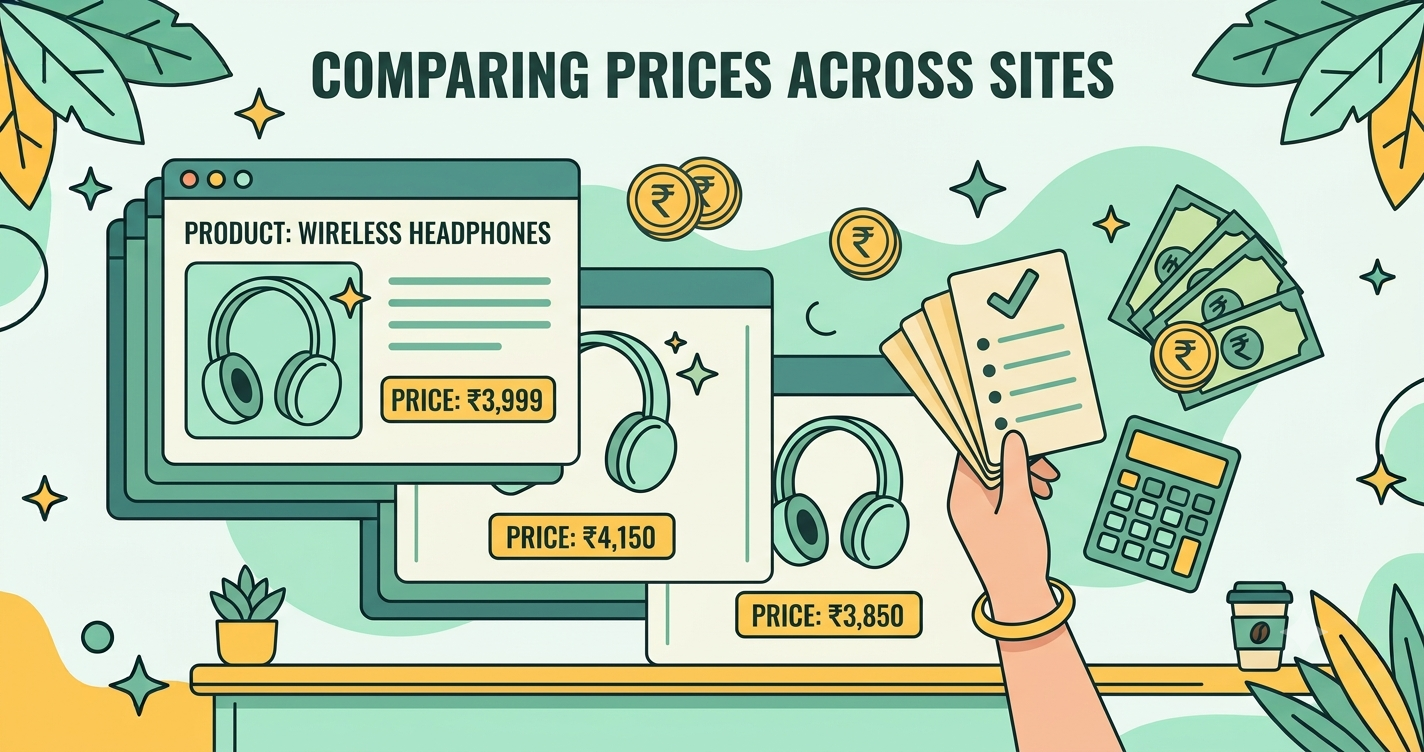
These numbers are illustrative. Suppose you want the same pair of headphones from three sources.
- Store A: 2,499, free delivery, 10% instant bank offer capped at 200. Effective price: 2,299.
- Store B: 2,299, delivery fee of 99, no offers. Effective price: 2,398.
- Brand website: 2,549, free delivery, 1-year extended warranty included, 5% cashback credited as store credit (value about 127, only usable on that site). Effective price: about 2,422, with extra warranty value.
Store B had the lowest headline price, but Store A is the cheapest after offers. The brand’s site costs about 123 more than Store A, which may be a fair price for the extra warranty if you value it. Without calculation, you might have chosen Store B and paid 99 more than necessary.
Step 5: Check the seller and authenticity
A low price is risky if the seller is unreliable. On marketplaces, look at:
- The seller’s rating and number of ratings.
- How long the seller has been active.
- Whether the seller is authorised by the brand, particularly for electronics and appliances.
- Reviews that mention authenticity, packaging, or after-sales support. Remember that reviews can be manipulated, so apply the checks in how to spot fake product reviews.
For branded goods, a lower price from an unauthorised seller may mean grey-market stock, older stock, or no manufacturer warranty. Confirm warranty terms with the brand before you buy.
Step 6: Compare warranty, returns and delivery time
These factors affect real value as much as price does.
- Warranty: Is it a manufacturer warranty or a seller warranty? How long does it last, and what does it cover?
- Returns: What is the return window? Is a defective product replaced or refunded? Who pays for return shipping? See return and refund policies explained.
- Delivery: How soon will it arrive? If you need the product by a certain date, a slightly higher price with faster delivery may be better.
- Payment options: Is COD available? Are there restrictions? See COD vs prepaid.
Step 7: Check the price history
Once you have the best current price, check whether it is also a good price over time. A quick chart shows whether today’s price is near the lowest level or well above it. If the price is high compared with the past few months, consider waiting or setting a price alert. Our guide to price history tracking shows how.
Step 8: Decide and buy
Choose the option with the best combination of effective price, trustworthy seller, and good terms. If two options are within a small margin, prefer the one with the clearer warranty and return policy. Take a screenshot of the product page and the final checkout total, keep the order confirmation, and note the expected delivery date.
Common mistakes when comparing prices
Comparing different variants
Different storage sizes, colours, or generations can look similar. Check the model number every time.
Ignoring delivery and fees
A low item price can be offset by a handling fee or slow delivery. Always check the cart total.
Counting offers you cannot use
A bank offer that requires a specific card does not help if you do not own it. Count only the offers you can truly use.
Trusting comparison sites blindly
Price comparison sites can lag behind live prices, and some highlight sellers that pay for placement. Use them for discovery, then confirm on the store’s page.
Spending hours to save a few rupees
Time has value. For low-cost items, a quick check of two stores is enough. Save deeper comparison for larger purchases.
Comparing only at one moment
Prices change. A comparison from last week may be outdated. Re-check the final price right before paying.
Comparing prices during sales
During big sale events, prices move quickly and stock can sell out. Prepare in advance: record normal prices for the items on your wishlist, then compare sale prices against that baseline. Some stores price match or adjust prices after purchase, but policies vary, so read the terms. Our festive sale shopping guide and flash sale strategy explain how to stay organised and avoid rushed decisions.
Comparing online with offline
For electronics, appliances, and furniture, an offline shop is worth checking. Local retailers may match online prices, offer free installation, and handle warranty claims directly. They may also let you see the product in person, which can prevent returns. Online stores often win on price, convenience, and variety. A short phone call to a local shop with your exact model number can settle the question in minutes.
How to build a simple comparison sheet
For larger purchases, a tiny table makes the decision almost automatic. Open a notes app or spreadsheet and create one row per seller with these columns: seller name, listed price, delivery cost, coupon value, bank offer, cashback you will really use, effective price, warranty, return window, and delivery date. Fill it in as you go. When the table is complete, the best option is usually obvious, and you will have a record to refer to if something goes wrong later.
If you are comparing several products rather than several sellers, add a column for the features you care about most, such as battery life, screen size, or capacity, and rate each product against them. This keeps you from being swayed by a single flashy discount, and it links naturally to the buying guides on this site, such as our budget smartphone buying guide.
When a price match or adjustment is possible
Some stores will match a lower price from a competitor, or credit the difference if the price drops soon after you buy. These policies are not universal and often come with conditions: the competitor must be a listed retailer, the product must be identical and in stock, and the request must be made within a short period. If you spot a lower price right after purchase, check the store’s policy and contact support politely with a screenshot. Even when there is no formal policy, some sellers will offer a coupon or partial credit to keep your business. It costs nothing to ask, and the worst answer is no.
Comparing services, subscriptions and travel
The same method applies beyond physical goods. For streaming plans, flights, and hotels, the headline price can hide taxes, fees, cancellation terms, and bundled extras. Compare the total including every charge, and read the cancellation rules, because a cheaper non-refundable option may cost more if your plans change. For ideas on these categories, see our guides to flight and hotel deals and OTT subscription savings.
A quick comparison checklist
- Exact model and variant noted.
- Two or three reputable sellers and the brand site checked.
- Effective price calculated for each.
- Seller reliability, warranty, and returns compared.
- Price history reviewed.
- Final price confirmed at checkout.
- Screenshots and order details saved.
Frequently asked questions
How do I compare prices across different websites?
Identify the exact model, check it on two or three reputable stores and the brand’s own site, then compare the effective price after delivery, coupons, bank offers, and cashback.
Is the lowest price always the best deal?
No. A slightly higher price from an authorised seller with a clear warranty and easy returns can be a better deal than a cheaper listing from an unknown seller.
Do price comparison websites show accurate prices?
They are usually close but can lag behind live changes. Always confirm the final price on the store’s own checkout page.
How many websites should I compare?
Two or three reputable online stores plus the brand’s site or one local shop is enough for most purchases. More than that gives diminishing returns.
Should I compare online prices with offline shops?
For expensive items, yes. Local shops may match or beat online prices, and you can inspect the product and get immediate support.
Final thoughts
Comparing prices is less about finding a rock-bottom number and more about making an informed choice. Match the exact product, calculate the effective price, and give weight to the seller, warranty, and return terms. Ten focused minutes can save you real money and prevent regrets. Make the method a habit, and you will find that good deals become easier to recognise, whatever the store or season.
Keep reading