Cash on Delivery vs Prepaid: Which Payment Option Is Better?
Quick answer: Prepaid is usually better when you are buying from a trusted store, because it often unlocks extra discounts, cashback and faster refunds, and avoids COD fees. Cash on Delivery is better when you are buying from an unfamiliar seller, trying a store for the first time, or want to inspect the order before paying. The best choice depends on how much you trust the seller and what the final price is after all offers.
You have found the product, checked the reviews, and reached the final step. The page asks a simple question: how do you want to pay? Two options sit side by side. One says “Cash on Delivery.” The other says “Pay online.” It looks like a small decision, but it can change how much you pay, how safe the purchase is, and how smoothly a refund works if something goes wrong.
This guide breaks down both options in plain language. You will learn what each one means, the real pros and cons, the hidden costs, how refunds differ, and a simple rule for choosing. If you are still building your overall shopping approach, it helps to understand how online deals work and how to stay protected with our online shopping safety guide.
What is Cash on Delivery (COD)?
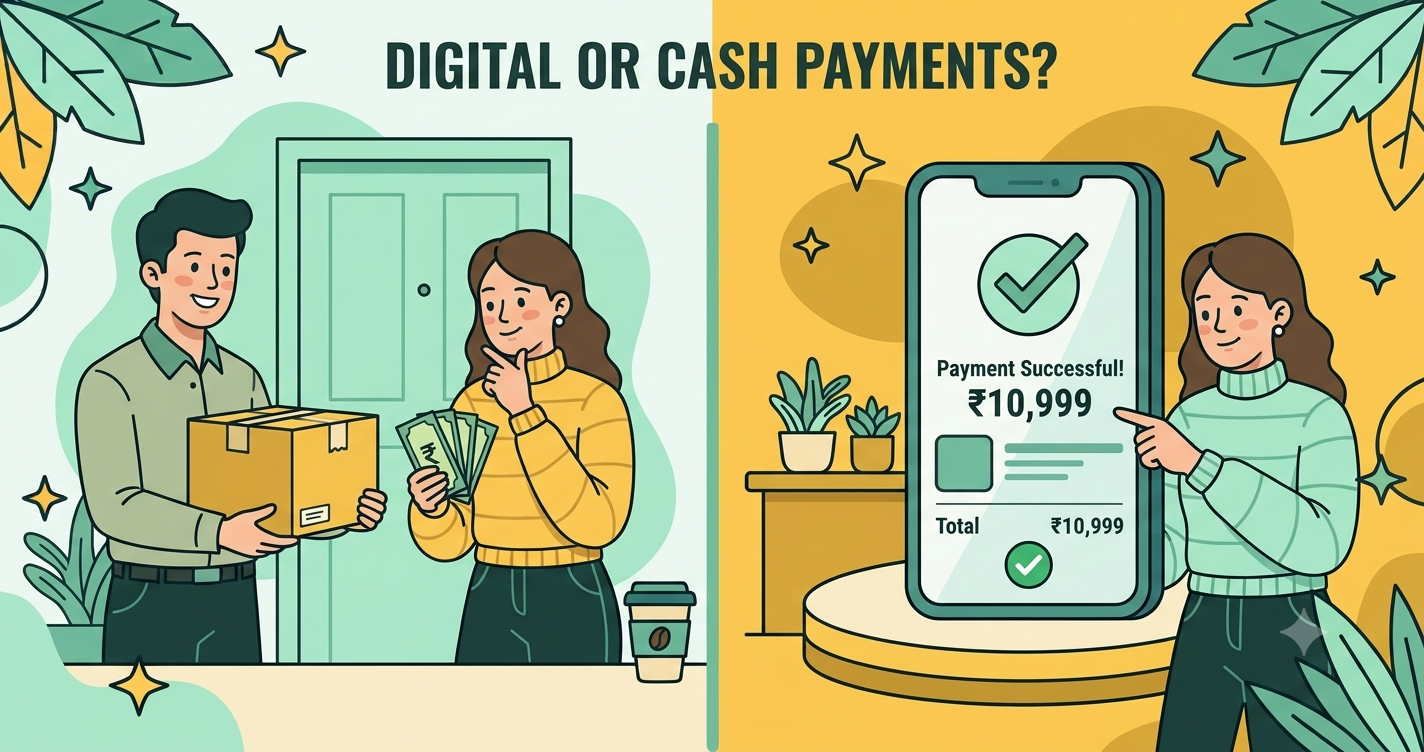
Cash on Delivery means you pay when the product reaches you. The delivery person hands over the parcel, and you give them the amount, usually in cash, though some couriers also accept UPI or cards on delivery. Until that moment, the seller has not received your money.
COD became popular in India because many shoppers were not comfortable sharing card details online, did not have cards, or wanted to be sure the product actually arrived before paying. It remains common today, especially for first-time buyers and for smaller cities and towns.
What is prepaid payment?
Prepaid means you pay online at checkout, before the order ships. The usual methods are UPI, debit and credit cards, net banking, wallets, and sometimes buy-now-pay-later or EMI options. The seller receives confirmation of payment and then processes your order.
Prepaid is the default for most large platforms because it reduces failed deliveries and returns-to-origin, and because it makes offers easier to apply. It is also generally the quickest way to get a refund, since the money can go back to the same source.
COD vs prepaid at a glance
- When you pay: COD at delivery; prepaid at checkout.
- Risk of non-delivery: COD has none for your money; prepaid depends on seller and platform protection.
- Extra fees: COD may carry a handling fee; prepaid usually has none.
- Offers and cashback: prepaid often qualifies for more; COD often qualifies for fewer or none.
- Refund speed: prepaid is usually simpler; COD often needs extra bank or wallet details.
- Convenience: prepaid is contactless; COD needs you to have the right amount ready.
- Availability: COD is not offered for every pincode, seller, or high-value item.
Advantages of Cash on Delivery
1. You do not pay for something that never arrives
This is the biggest benefit. If the seller is unknown or the website is new, COD protects your money until the parcel is in your hands. For suspicious or unfamiliar stores, it is a sensible safety measure, though it does not remove every risk.
2. You can check the parcel at the door
You can look at the packaging before paying. If it is torn, wet, or clearly tampered with, you can refuse the delivery. Some sellers allow you to open the box in front of the delivery person, but this varies, so check the policy first.
3. No need to share financial details
If you are uncomfortable entering card or bank details on a new site, COD avoids that step entirely.
4. Helpful for people without cards or online banking
COD makes online shopping accessible to people who do not use digital payments regularly.
Disadvantages of Cash on Delivery
1. Extra COD or handling fees
Many stores add a small fee for COD to cover the cost of cash handling and failed deliveries. It may look minor, but on a low-priced item it can erase your savings.
2. Fewer offers
Bank offers, wallet cashback, and prepaid-only discounts do not apply to COD. Over time, this can make COD more expensive. See bank offers and credit card deals and how cashback works for what you may be missing.
3. Refund friction
Since you paid in cash, the seller needs somewhere to send the refund. You may have to provide bank or UPI details, or accept store credit. This adds steps and sometimes delay.
4. Order cancellation risks
If you refuse a COD parcel without a valid reason, some platforms may restrict COD on your account in the future. Repeated refusals can limit your payment options.
5. You must be available with payment ready
A missed delivery or a lack of change can lead to a failed attempt and delays.
Advantages of prepaid payment
1. Better prices through offers
Prepaid orders frequently qualify for card discounts, UPI cashback, wallet rewards, and no-cost EMI offers. Check the conditions, because caps and minimum spends apply. We explain these in UPI cashback offers and how to stack coupons, offers and cashback.
2. No COD fee
You avoid handling charges, so the price you see is closer to the price you pay.
3. Simpler, faster refunds
For prepaid orders, refunds typically return to the original payment method, which means less paperwork. Timelines depend on the seller and your bank, and some platforms offer faster refunds to wallet or store credit.
4. Contactless and convenient
You do not need to be home with cash, and you can ask the courier to leave the parcel in a safe place if the seller allows it.
5. Better record keeping
Digital payments create a transaction record, which helps if you need to raise a dispute.
Disadvantages of prepaid payment
1. Your money is committed before you see the product
If the product is not delivered or is misdescribed, you must go through a refund or dispute process.
2. Risk on unfamiliar sellers
Paying a new, unverified seller with a direct transfer is risky, because you may have no buyer protection. Pay only through the official checkout. Our guide on online shopping safety explains how to check a seller.
3. Exposure to payment fraud
Entering payment details on a fake website or sharing an OTP can lead to losses. Using reputable sites and never sharing codes lowers this risk considerably.
4. Temptation to overspend
Fast digital payments make impulse buying easier. If this applies to you, read how to avoid impulse buying during sales.
Which is cheaper in practice?
Here is a worked example using made-up numbers. A pair of shoes costs 2,500. With prepaid, a bank offer gives 10% off, up to 200, and there is no extra fee. With COD, there is a 40 handling fee and no bank offer.
- Prepaid: 2,500 − 200 = 2,300
- COD: 2,500 + 40 = 2,540
The difference is 240, or about 10% of the price. On a single order, it is a small amount. Over many orders, it adds up. The cheapest method is the one with the lowest final price after every fee and offer, which is the same principle we use for comparing deals across stores in how to compare prices across websites.
Safety: is COD really safer?
COD is safer in one specific way: you do not pay before receiving the parcel. It is not safer in every way. You can still receive the wrong item, a damaged item, or a low-quality copy. You may also be pressured at the door to pay quickly. And if there is a problem, your refund will depend on the seller’s process.
Prepaid is safe on trusted platforms that offer buyer protection and clear refund terms. It is riskier with unknown websites, social media sellers, or off-platform payment requests. The safest approach is to match the payment method to the seller: COD or small test orders for unfamiliar ones, prepaid for well-established ones.
How refunds differ
Prepaid orders
Your refund usually goes back to the original payment method after the seller receives the returned item or approves the return. Banks can take several working days to show the credit. Some platforms provide faster options such as credit to a wallet.
COD orders
Because no digital payment exists, the seller needs your account details or issues store credit or a voucher. Verify these details carefully and use only the official refund form inside the app or website. Fake “refund agents” are a known scam, as described in our safety guide. For the broader process, see return and refund policies explained.
COD tips if you choose it
- Keep the exact amount ready, or use the digital payment option on delivery if available.
- Check the packaging before paying. Take a quick video when opening the parcel if the seller allows it.
- Confirm that the invoice amount matches the amount the courier asks for.
- Do not pay extra “delivery” or “service” charges that were not shown at checkout.
- Keep the bill and order details for returns.
Prepaid tips if you choose it
- Pay only through the official checkout page and check the website address.
- Use a payment method that carries a relevant offer and read its limits.
- Save the order confirmation and the payment reference.
- Never share an OTP or PIN with anyone claiming to be support.
- Track the refund timeline and follow up if it exceeds the promised period.
When COD is not available
You may notice that the COD option is missing or greyed out at checkout. This is normal. Stores often switch it off for certain pincodes, for high-value items, for fragile goods, or for accounts with a history of refused deliveries. Some platforms also limit COD during big sale events to reduce failed deliveries. If COD is unavailable and you are not comfortable paying upfront, consider a smaller test order from the same seller first, or choose a store that offers stronger buyer protection and clear return terms.
A simple rule for choosing
- Do I know and trust this seller? If yes, prepaid is usually better. If no, consider COD or avoid the purchase.
- Is the price lower with prepaid after fees and offers? If yes, and risk is low, choose prepaid.
- Is the product expensive or fragile? Check return terms carefully, and consider payment methods with dispute support.
- Can I be home to receive and pay? If not, prepaid avoids a failed delivery.
Frequently asked questions
What is the difference between COD and prepaid?
With Cash on Delivery you pay when the order arrives. With prepaid you pay online at checkout, before the order ships, using a card, UPI, net banking, or wallet.
Is cash on delivery cheaper than prepaid?
Usually not. Many stores add a COD handling fee and offer extra discounts, cashback, or bank offers only on prepaid orders.
Is COD safer than paying online?
COD protects you from paying for an order that never arrives. But you can still receive a wrong or damaged item, and you must still follow the return process.
How do refunds work for COD orders?
Because you paid in cash, the seller usually needs your bank, UPI, or wallet details to send the refund. Timelines and methods vary by store, so check the policy before ordering.
When should I choose prepaid?
Choose prepaid when you trust the seller and a prepaid-only offer, cashback, or lower fee makes the final price cheaper. It also helps if you will not be home to pay in cash.
Final thoughts
Neither option is always better. COD is a reasonable shield when you are testing a new seller or are unsure about a website, while prepaid usually wins on price, speed, and refund simplicity when you are dealing with a trusted store. The habit worth building is to compare the final price and the risk, not just the convenience. Once you do, the choice usually becomes obvious in a few seconds, and you will keep more of your money while staying protected.
Keep reading