
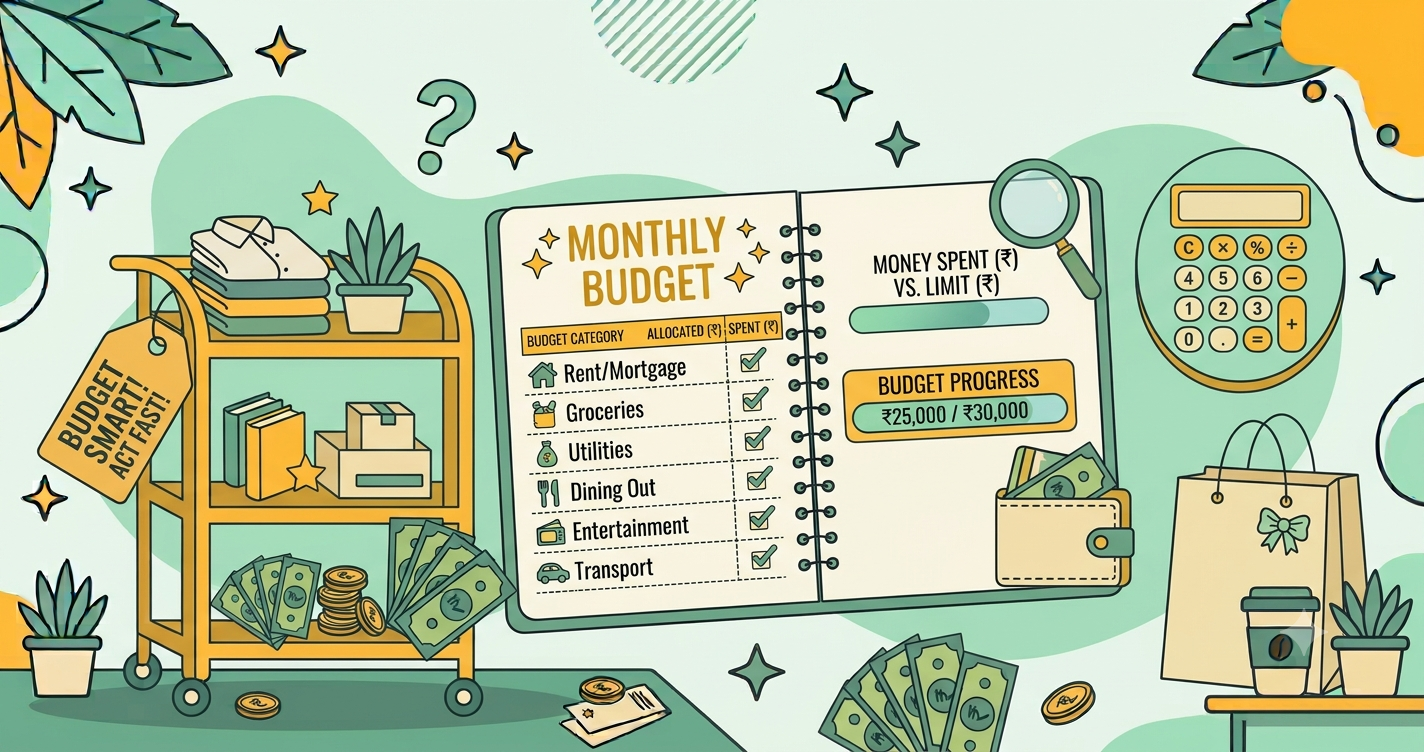
Category: Smart Buying | Reading time: about 15 minutes
How to Plan and Stick to a Shopping Budget (Step-by-Step)
Quick answer: To plan a shopping budget, calculate your monthly income, subtract fixed bills and savings, then divide what remains into categories such as groceries, clothes, gadgets, gifts, and fun. Track every purchase, review monthly, and adjust. To stick to it, use a wishlist, set a spending cap for sales events, wait before unplanned buys, and keep a small buffer for surprises. A budget works when it is simple enough to follow.

Shopping is one of the easiest places for money to disappear. Small purchases, convenient apps, constant sales, and the pressure of festivals can add up faster than you realise. At the end of the month, you may wonder where your money went, even though no single purchase felt large.
A shopping budget solves this by giving your spending a plan. It does not mean never buying things you enjoy. It means deciding in advance how much you can spend, so that you enjoy purchases without stress. This guide walks you through creating a budget step by step, tracking your spending, handling sales and festivals, dealing with overspending, and building habits that last. It ties together many ideas from our other guides, such as how to avoid impulse buying during sales, festive sale shopping, and saving on online groceries.
Why a shopping budget matters
- It shows where your money goes. Many people underestimate how much they spend on small items.
- It protects your priorities. Essentials and savings come first, so shopping does not crowd them out.
- It reduces stress. Knowing your limit lets you spend without guilt inside it.
- It makes deals meaningful. A discount is only a saving if the purchase fits your plan.
- It prevents debt. Staying within your means avoids high-interest borrowing.
Step 1: Know your income
Start with your monthly take-home income, meaning what you actually receive after taxes and deductions. If your income varies, use a conservative estimate based on the lowest months or an average over the past six to twelve months. Include all regular sources, such as salary, freelance income, and allowances, but do not count uncertain money like bonuses until you receive it.
Step 2: List fixed expenses and savings
Before deciding how much to spend on shopping, list expenses you must pay or commit to each month:
- Rent or housing costs.
- Utilities, internet, and phone bills.
- Loan and EMI repayments.
- Insurance premiums.
- Transport and commuting.
- Education fees.
- Subscriptions. See saving on OTT subscriptions.
Then set aside savings. A common approach is to save first, rather than save what is left over. Even a small, regular amount builds a safety cushion. Having an emergency fund reduces the need to use credit when unexpected expenses arise.
Step 3: Calculate what is left for variable spending
Subtract fixed expenses and savings from your income. What remains is your pool for variable spending: groceries, household items, clothes, personal care, entertainment, gifts, dining out, gadgets, and shopping in general. This is the amount your shopping budget must fit within.
Step 4: Divide the pool into categories
Break your variable spending into categories that match your life. Examples include:
- Groceries and household supplies.
- Clothing and footwear.
- Electronics and gadgets.
- Home and furniture.
- Personal care and health.
- Gifts and occasions.
- Entertainment and dining out.
- Miscellaneous or “fun money.”
- A buffer for unexpected costs, usually five to ten percent.
Some people use a simple rule of thumb that splits income into needs, wants, and savings. The exact percentages vary, and it is a starting point rather than a rule. Adjust to your circumstances, such as high rent or family responsibilities. What matters is that your plan is realistic and that you can follow it.
Step 5: Plan for irregular and seasonal expenses
Many budgets fail because they ignore irregular expenses. Festivals, weddings, birthdays, annual insurance, school fees, and sales events can suddenly require large amounts. To handle them:
- List the big irregular expenses you expect over the next twelve months.
- Estimate the cost of each.
- Divide the total by twelve, and set aside that amount monthly in a separate “sinking fund.”
- When the event arrives, use the saved money instead of borrowing or cutting essentials.
For seasonal planning, see how to shop smart during Diwali sales and wedding season shopping on a budget.
A worked example (illustrative numbers)
Suppose your monthly take-home income is 50,000.
- Fixed expenses: rent 15,000, utilities and phone 3,000, transport 4,000, loan EMI 5,000, insurance 1,000, subscriptions 800, for a total of 28,800.
- Savings: 7,500 (15 percent).
- Remaining for variable spending: 50,000 − 28,800 − 7,500 = 13,700.
You divide the 13,700 as follows: groceries and household 6,000, personal care and health 1,000, clothing 1,200, electronics and gadgets 1,000, gifts and occasions 1,000, entertainment and dining out 1,500, a sinking fund for festivals 1,000, and a buffer of 1,000. The total is 13,700. Now when you see a sale on headphones, you know that you have 1,000 per month for gadgets, and you can decide whether to save for a month or two. The budget gives you a framework for saying yes or no, and removes the guesswork. These numbers are illustrative. Your own numbers will differ, but the process is the same.
Step 6: Choose a tracking method
A budget only works if you track what you spend. Choose a method you will actually use:
- Budgeting apps, which categorise transactions automatically and show progress.
- Spreadsheets, which are flexible and free, but need manual updates.
- Bank and card statements, reviewed weekly or monthly.
- Cash envelopes, where you withdraw cash for categories like entertainment and stop when it is gone.
- A notes app, where you quickly log purchases.
Whichever you choose, record purchases promptly, and review weekly. Small, frequent check-ins are easier than a big monthly cleanup. If you use credit cards, track the total outstanding amount, and pay in full each month.
Step 7: Set rules for shopping
Rules make decisions easier. Examples:
- The wishlist rule. Add non-essential items to a wishlist and wait at least 24 hours before buying.
- The cost-per-use rule. Ask how often you will use the item, and divide the price by expected uses.
- The one-in, one-out rule. For clothes and gadgets, replace rather than accumulate.
- The sale-cap rule. Set a maximum spend for each sale event, and stop when you reach it.
- The no-browse rule. Avoid opening shopping apps without a purpose.
- The cash-or-debit rule for wants. Use payment methods that make overspending harder.
Step 8: Use deals as a tool, not a driver
Sales, coupons, and cashback can stretch your budget, but only if you buy things you planned to buy. Use a wishlist and target prices, and compare effective prices. See price history tracking, how to compare prices across websites, how to stack coupons, offers and cashback, and 12 ways to spot a fake discount. Remember that the best discount is the one on an item you were already going to buy.
Step 9: Be careful with credit, EMI, and buy-now-pay-later
Credit can help in emergencies and for large planned purchases, but it can also hide overspending. Before using credit or EMI, make sure the monthly payment fits your budget, and understand fees and interest. See no-cost EMI explained and bank offers and credit card deals. Avoid using credit to fund wants that are beyond your budget. If you already carry debt, prioritise paying it down, since interest can outweigh any discount you earn.
Step 10: Review monthly and adjust
At the end of each month, compare actual spending with your budget:
- Where did you overspend, and why?
- Where did you underspend, and can you redirect that money to savings or another priority?
- Did irregular expenses catch you by surprise? Add them to your sinking fund plan.
- Do your categories still make sense, or do they need adjusting?
- What one change will make next month easier?
A budget is a living plan. It should change with your income, expenses, and goals. Do not abandon it after one bad month, since the review is where you learn.
Dealing with overspending
Everyone overspends sometimes. When it happens:
- Do not panic or give up. One miss does not mean the budget failed.
- Identify the cause: an emotional purchase, a surprise expense, or an unrealistic limit.
- Adjust the next month’s limits, and use your buffer or sinking fund for genuine surprises.
- Avoid borrowing to cover the gap, unless it is an emergency.
- Consider whether the budget is too tight to follow. A budget that is too strict often fails.
Budgeting for shared households and families
If you share expenses with a partner, family, or housemates, talk openly about goals and limits. Agree on how to split shared costs, who tracks spending, and how to handle disagreements about discretionary purchases. Some households keep a joint account for shared expenses and individual allowances for personal spending, which can reduce conflict. Involve children in age-appropriate ways, by teaching them to compare prices and make choices within a limit. A budget works best when everyone understands and supports it.
Common budgeting mistakes
Making the budget too strict
If there is no room for enjoyment, you will break it. Include fun money.
Ignoring small purchases
Daily snacks, app purchases, and delivery fees add up. Track them.
Forgetting irregular costs
Festivals, repairs, and annual fees need planning. Use sinking funds.
Not tracking
Without records, a budget is only a wish. Track consistently.
Setting unrealistic savings targets
Choose an amount you can maintain, and increase gradually.
Being swayed by marketing
Sales and “limited time” offers are designed to override plans. Pause, check your list, and wait. See flash sale strategy.
Mixing needs and wants
Label items honestly. A “need” is something you cannot do without, and a “want” is something you would like.
Simple habits that make budgets stick
- Check your budget at a regular time each week.
- Automate savings and bill payments to reduce forgetting and temptation.
- Unsubscribe from promotional emails and turn off shopping notifications.
- Keep a running wishlist with prices and dates.
- Celebrate small wins, such as a month within budget.
- Review your goals, such as an emergency fund, a trip, or a major purchase, so the budget has a purpose.
Frequently asked questions
How do I make a shopping budget?
Add up your monthly income, subtract fixed bills and savings, and set limits for variable categories such as groceries, clothes, gadgets, and gifts. Track spending and adjust each month.
How much of my income should go to shopping?
There is no single right figure. Many people start with a simple guideline such as needs, wants, and savings, then adjust to their situation. Make sure essentials and savings come first.
How can I stick to my budget during sales?
Use a wishlist, set a spending cap for the event, wait 24 hours on unplanned items, avoid browsing without a purpose, and track purchases as you go.
What if I overspend one month?
Review what happened, adjust next month’s limits, and avoid borrowing to cover the gap. Small misses are normal, and the goal is to learn from them.
Should I use cash, cards, or apps to track spending?
Use whichever method you will actually follow. Apps and statements give accurate records, while cash envelopes can help control categories. Many people combine methods.
Final thoughts
A shopping budget is a tool for freedom, not restriction. It lets you spend on what matters, avoid regret, and build savings. Start simple: know your income, list fixed costs, set category limits, track your spending, and review each month. Add rules for sales and festivals, and be kind to yourself when you slip. Over time, the habit becomes natural, and the deals you choose become the ones that truly fit your life.
This article is general information, not financial advice. For decisions about debt, investments, or insurance, consider speaking with a qualified professional.


3 thoughts on “How to Plan and Stick to a Shopping Budget (Step-by-Step) | Deal Fyndr”