
Category: Shopping Basics | Reading time: about 13 minutes
12 Ways to Spot a Fake Discount Before You Buy
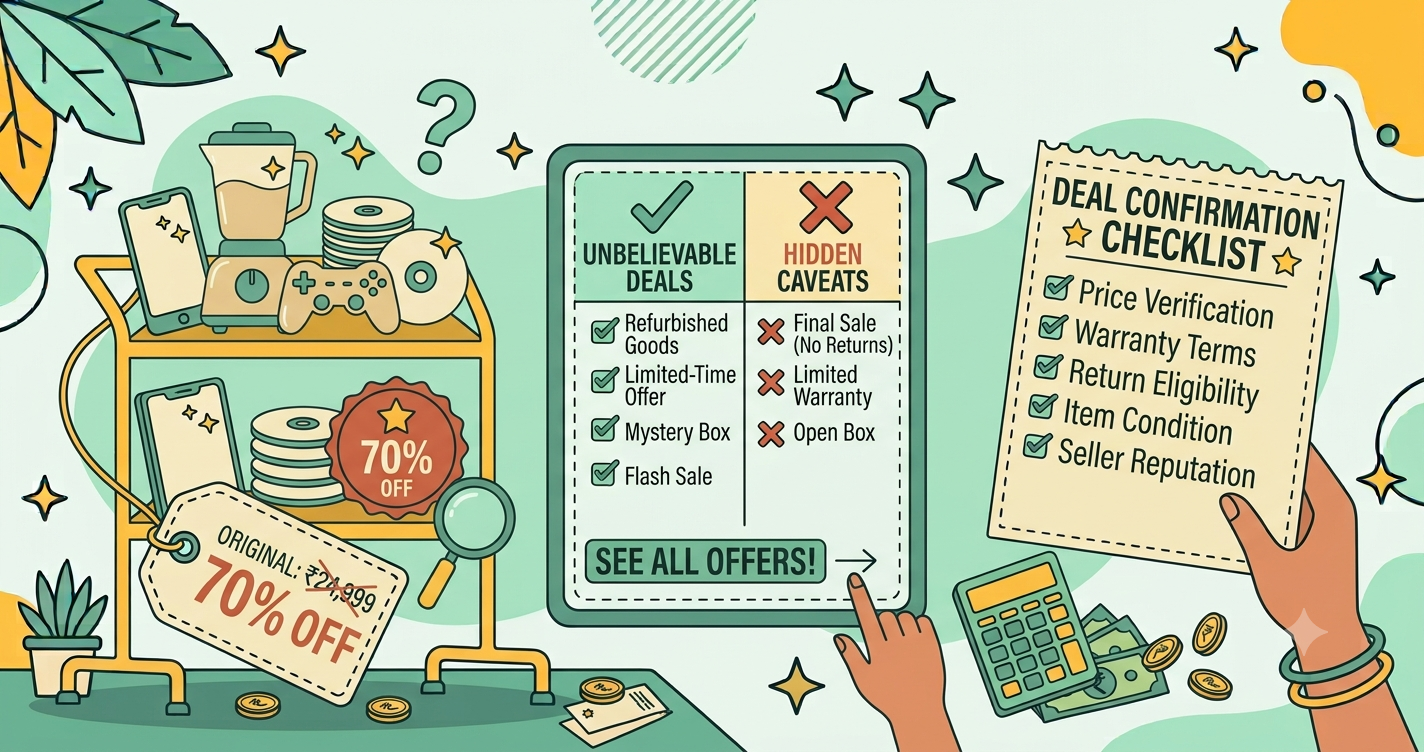
Quick answer: A fake discount is a price cut that looks larger than it truly is. The most common tricks are an inflated original price, a “was” price that never existed, false urgency from timers and stock labels, and confusing bundles. To spot one, check the product’s price history, compare the final price on other stores, calculate your saving against the typical price instead of the MRP, and read every condition before paying.

Most people have had this experience. You see a product at “80% off,” you buy it quickly, and later you notice the same item at a similar price elsewhere, or you realise it was never worth the original number. The feeling is not just regret about money. It is the sense of having been played.
Fake discounts are not always illegal, and not every seller who uses them is dishonest. Many are simply aggressive marketing built on psychology. But whether the trick is deliberate or just habit, the effect on you is the same: you pay more than you think you are saving. The good news is that there are clear, repeatable checks you can use. This guide gives you twelve of them, along with the reasoning, so you can apply them to any store.
If you are new to the topic, it helps to read how online deals work first, because it explains why sellers discount in the first place.
Why fake discounts work
Fake discounts work because of how human judgment is wired. We rarely know what something “should” cost, so we judge by comparison. A high crossed-out price gives us an anchor, and any lower number feels like a win. Add a countdown timer, and our fear of missing out does the rest. Scarcity labels, social proof such as “2,000 bought this today,” and bright colours all push in the same direction: buy now, think later.
Once you understand that these tools target feelings rather than facts, you can slow down and check the facts. The twelve methods below do exactly that.
1. Check the price history
This is the single most effective test. A price chart shows what the product has actually sold for over recent months. If the item has hovered around the same price for half a year and now displays “60% off,” the discount is mostly decoration. If today’s price is at or near the lowest point on the chart, the deal is probably real. Our step-by-step guide on how to check price history shows how to do this in a few minutes.
2. Look at the MRP with suspicion
MRP is the maximum a packaged product may be sold for, not its fair value. A very high MRP makes any selling price look like a bargain. When a product is “always 70% off” its real price is simply the selling price, and the MRP is a stage prop. Read MRP vs selling price to learn how to calculate a more honest saving.
3. Compare the final price on other stores
A discount means nothing if another store sells the same item cheaper without any fanfare. Spend five minutes checking two or three reputable sellers. Make sure the model, size, and warranty match. Our guide on comparing prices across websites gives a simple process.
4. Be wary of “was” prices with no source
A strikethrough price labelled “was” or “original” may reflect a price the item was listed at for a single day, or never sold at all. Reputable sellers explain what the reference price means, such as the average over a period. If there is no explanation, treat the “was” price as marketing.
5. Question countdown timers
“Offer ends in 02:14:09” creates pressure. Some timers are genuine. Others reset when you reload the page or are replaced by a new timer the next day. Open the page in a private window or return later. If the same timer appears again, it was a nudge, not a deadline. Our flash sale strategy guide explains how to stay calm during short-window offers.
6. Treat “only 2 left” as a prompt to verify
Low-stock labels can be true. They can also be generic messages designed to speed you up. Check whether other sellers have the same product, and whether the “low stock” warning appears on several items at once. If everything on the page is almost sold out, none of it probably is.
7. Watch for the pre-sale price rise
Some sellers raise a product’s price a week or two before a big sale and then “discount” it back to the original price. The price history chart shows this as a small hill before the sale dip. If you see that shape, your real saving is much smaller than the label claims. Planning around events, as described in our festive sale shopping guide, helps you avoid this trap.
8. Convert percentages into rupees
“Up to 70% off” often applies to a handful of low-value items. A 50% discount on a 200 item saves 100, while 10% off a 20,000 item saves 2,000. Always translate the offer into the amount you will actually save, and compare that with the effort and risk involved. Remember that “up to” means the maximum for a few products, not the typical discount.
9. Check that the product is truly the same
A product that looks identical may be a slightly different model, an older version, or a lower-capacity variant. Compare the model number, storage, size, material, and warranty terms. Some sellers show the discount for one version and ship another. Confirm that the item in your cart matches the item you researched.
10. Add up the hidden charges
A low price can come with delivery fees, handling fees, installation charges, or mandatory add-ons. Check the cart total, not just the product page. If you are offered EMI, look for processing fees and interest, which we explain in no-cost EMI explained. A “free” offer that adds cost elsewhere is not free.
11. Read the conditions on coupons and bank offers
Many offers apply only above a minimum order value, on certain cards, on selected categories, or only for the first purchase. A banner that says “extra 20% off” may be capped at a small amount. Read the terms before assuming you will get the full discount. For a clearer picture, see our guides on coupon codes and bank offers and credit card deals.
12. Check reviews, return policy, and seller details
A suspiciously low price from an unknown seller can signal a counterfeit product, a poor-quality version, or a scam. Read recent reviews, look for photos from real buyers, and confirm the seller’s return policy. Reviews themselves can be manipulated, so learn the signs in how to spot fake product reviews. If the seller is unfamiliar, read our online shopping safety guide before paying.
A quick scoring method
If you want something faster than twelve separate checks, use this five-question score before buying. Give one point for each “yes.”
- Is today’s price near the lowest in the last three months?
- Is it cheaper than at least two other reputable sellers?
- Are all charges and conditions clear?
- Is the return policy acceptable?
- Would I buy it at this price even without the discount label?
Four or five points means a likely good deal. Two or three means proceed carefully or wait. Zero or one means the discount is probably more marketing than value.
A worked example
A backpack shows MRP 3,500 and a selling price of 1,099, “69% off.” You check the price history and see it sold between 1,049 and 1,199 for the past four months. Another store lists it at 1,149 with free returns. Your real saving against the typical price (about 1,125) is roughly 2%. The product may still be a good purchase if you need it, but the “69%” is not the reason. You could also wait for a sale where the price dips noticeably below the usual range.
Compare that with a pair of sneakers with MRP 4,999, selling price 2,499, and a price history that shows the usual price of 3,299. The saving is around 24%, which is real, even though it is smaller than the 50% label. The difference between the two examples is exactly what the twelve checks reveal.
Common fake-discount patterns by category
- Electronics accessories: very high MRPs and permanent “sale” prices.
- Fashion: constant “end of season” sales on items that are always discounted. See end of season sale guide to learn what a genuine clearance looks like.
- Home and kitchen: bundles where the “free” gift has little real value.
- Large appliances: offers that depend on exchange values or specific cards.
- Online courses and subscriptions: permanent “limited time” discounts and recurring countdowns.
Why genuine discounts still exist
It would be unfair to say every discount is fake. Genuine reductions happen for clear reasons: old models are cleared before a new launch, seasonal stock is cut at the end of its season, and large events bring competing stores into real price battles. The difference is that genuine discounts leave evidence. The price falls below its normal range, other sellers often follow, and the saving survives the checks above. When you see that pattern, buy with confidence. Knowing that real deals exist is what keeps this habit useful rather than cynical, and it connects to the timing advice in our guide to the best time to buy electronics.
What to do if you think you were misled
- Take screenshots of the product page, price, and offer terms.
- Contact the seller or platform’s support and explain the issue clearly.
- Ask for a refund or replacement, and note the date and reference number.
- If the problem is not resolved, use official consumer complaint channels. In India, the National Consumer Helpline is one starting point. Check official sources for the current process.
This is general information, not legal advice, and rules can change. For returns and refunds, see our guide on return and refund policies.
Protect yourself from impulse
The biggest weakness fake discounts exploit is speed. When you are rushed, you skip the checks. Build a simple rule: wait at least one hour, or overnight for anything expensive. If the deal is real, it will usually survive the wait or return soon. If you struggle with this, read how to avoid impulse buying during sales.
Frequently asked questions
What is a fake discount?
A fake discount is a price cut that looks bigger than it really is, usually because the original price was inflated, never charged, or the comparison is misleading.
How can I quickly check if a discount is real?
Check the product’s price history, compare the final price on two or three other stores, and calculate your saving against the typical price rather than the printed MRP.
Are countdown timers on shopping sites real?
Some are accurate, but many reset or repeat. Treat a timer as a prompt to verify the price, not as proof that the deal will vanish.
Is a 70 percent discount suspicious?
Not automatically. Clearance sales can reach that level. It becomes suspicious when the product is always at that discount or the original price looks unrealistic.
Where can I report a misleading offer?
You can complain to the seller or platform first, then use consumer protection channels such as the National Consumer Helpline in India. Check official sources for the current process.
Final thoughts
Fake discounts thrive on speed and assumption. The antidote is a short, steady routine: check the history, compare the price, read the conditions, and ask whether you want the product at this price. None of these steps is difficult, and together they take only a few minutes. Over a year, they can save you far more than any single coupon. Keep the twelve checks handy, and you will find that genuine bargains stand out clearly once you know what a staged one looks like.


One thought on “12 Ways to Spot a Fake Discount Before You Buy | Deal Fyndr”