Category: Coupons & Cashback | Reading time: about 14 minutes
Discounted Gift Cards: A Safe Buying Guide
Quick answer: Discounted gift cards can save money when you buy them from official or reputable sources during promotions and use them at stores where you already shop. They become risky when you buy from unknown sellers, ignore expiry and usage rules, or share the card code carelessly. Check the seller, the terms, the expiry date, and the balance before paying, and use the card soon after buying.

Gift cards are more than presents. They have become a tool for shoppers: buy a card at a discount, or with bonus credit, and spend it at a store you already use. Banks, payment apps, and platforms often run promotions on them. When it works, you effectively pay less for the same shopping.
But gift cards also carry risks that ordinary purchases do not. They behave like cash, so a stolen or used code is hard to recover. Scammers love them. Rules about expiry, balance, and refunds vary widely. This guide explains how discounted gift cards work, where to find real deals, the rules to check, the scams to avoid, and the best ways to use them. It connects with other guides in this series, including how to stack coupons, offers and cashback and online shopping safety.
How gift cards work
A gift card stores a prepaid balance that can be spent with a particular store or a group of stores. It can be physical, with a scratch panel or barcode, or digital, delivered by email, SMS, or app, usually with a code and sometimes a PIN. When you pay, you enter the code or show it at the till, and the system deducts the amount from the balance.
There are two main types:
- Closed-loop cards, usable only at one brand or its group of stores.
- Open or multi-brand cards, usable at many stores or on a wide network, often issued by banks or payment providers.
Why gift cards are sometimes discounted
Gift cards are discounted for a few reasons, and understanding them helps you judge which deals are real.
- Promotions by platforms and banks. A platform may sell a 1,000 card for 950 to bring in customers, or add bonus credit to certain denominations.
- Brand campaigns. Brands may offer extra value during festivals or sales, such as “buy 2,000 and get 200 extra.”
- Cashback and reward deals. A card issuer or payment app may pay you a reward for buying a gift card, which effectively makes it cheaper.
- Corporate bulk purchases. Some resellers buy cards in bulk at a discount and pass part of it on.
- Unauthorised resale. Some sellers offer deep discounts on cards obtained improperly. These are the riskiest and are best avoided.
Where to buy discounted gift cards safely
The brand’s official website or app
The safest source. The brand may run its own offers, such as bonus credit for larger amounts.
Major shopping platforms
Well-known marketplaces sell digital gift cards for many brands, often with offers tied to bank cards or payment apps.
Bank and card reward portals
Many banks let you buy gift cards using reward points or at a small discount through their portals. Read the terms about expiry and refunds.
Authorised retailers
Supermarkets, electronics stores, and other major retailers often sell cards in-store and online.
Payment apps and wallets
Some apps run offers on gift card purchases. Check that the card is issued by the brand or an authorised partner.
Where not to buy
- Social media sellers and messaging groups offering “50% off” gift cards.
- Unknown resale websites with no clear company details or buyer protection.
- Auction listings that offer codes only, with no verification.
- Strangers who ask you to pay first by direct transfer.
If a deal is far deeper than anything the official sources offer, it is probably not what it seems.
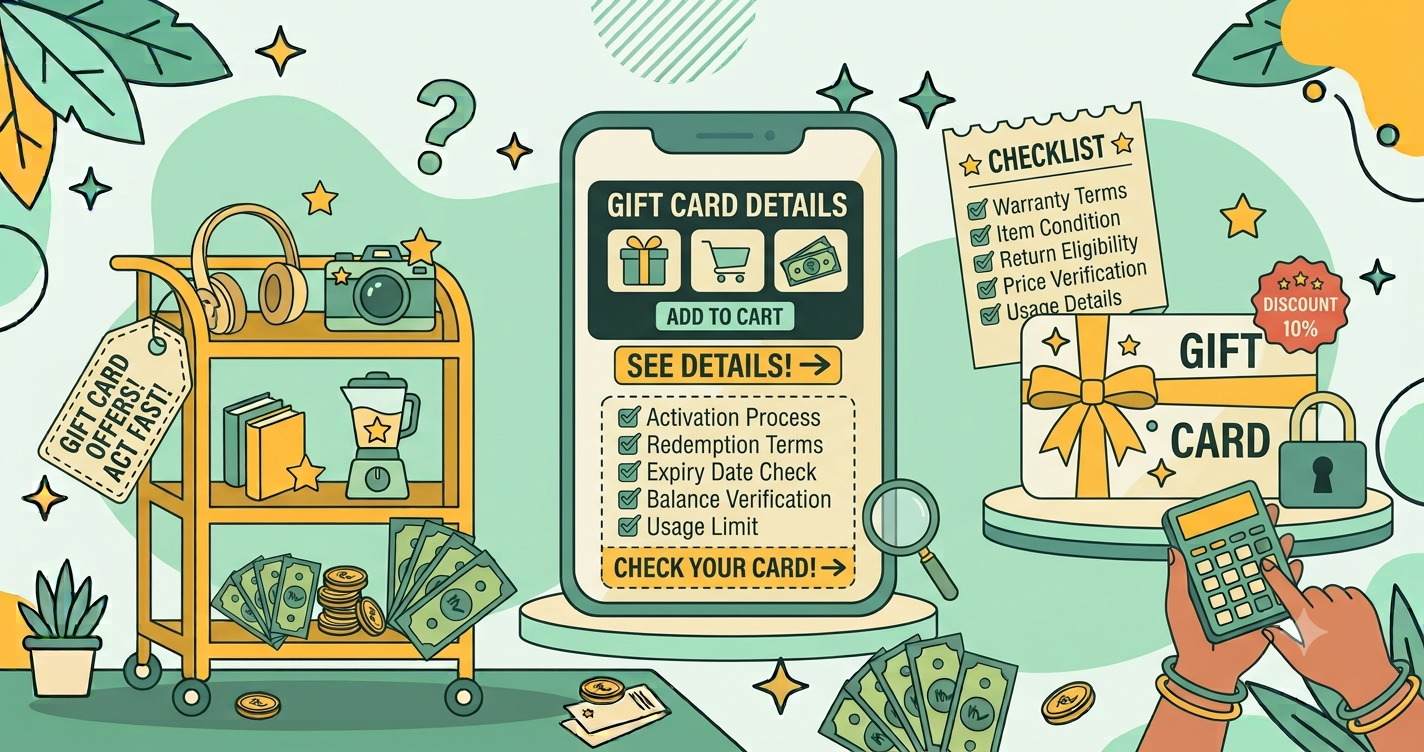
Rules to check before you buy
- Who issued the card? Confirm that it is the brand or an authorised partner.
- Where can it be used? Some cards work only online, only in-store, or only on selected products.
- What is the validity? Note the expiry date. Some cards expire in months, others in years.
- Can it be combined with offers? Some stores do not allow gift cards on discounted items or in combination with certain coupons.
- Can the balance be refunded or transferred? Many cards are non-refundable, and unused balance may be lost.
- What happens if the order is returned? The refund may go back to the gift card or as store credit. See return and refund policies explained.
- Is there a fee? Some cards charge activation or maintenance fees.
- Is there a minimum or maximum amount? Limits may apply to a single transaction.
A worked example (illustrative numbers)
You regularly shop at a store and expect to spend about 5,000 there over the next two months. A payment app offers a 1,000 gift card for 950, and your card gives an extra 2% cashback on the purchase. Two options:
- Buy five cards at 950 each: you pay 4,750 for 5,000 of store credit, saving 250, plus any cashback.
- Pay directly at the store: 5,000, with whatever store offers apply.
The gift card route saves about 250, or 5%, as long as you actually spend all of it before it expires, and as long as the store’s own discounts still apply when paying with a gift card. If the store offers a bank discount worth 7% for card payments and does not allow it on gift card purchases, paying directly might be better. Also, if the cards expire in six months and you only spend 3,000 in that period, your saving disappears. The best use of discounted gift cards is for spending you were already going to do, within the validity period. This is the same logic we apply in comparing prices across websites: count the effective price, not the label.
Common gift card scams
The “pay with gift cards” demand
A caller claims to be from a tax office, a bank, a utility, or tech support, and demands payment in gift card codes. No legitimate government agency or company demands payment in gift cards. Stop and do not share the codes.
Too-good-to-be-true discounts
Sellers offering 40% to 60% off cards are often selling codes obtained through stolen cards or fraud, and the codes may be cancelled after you buy. Others sell cards that have already been used.
Fake giveaways
Messages claiming that you have won a gift card, and asking you to click a link or enter your details, are common phishing tricks.
Card draining
Criminals sometimes record the codes on physical cards in stores and check them until the balance is loaded, then drain them. Inspect physical cards for tampering, such as scratched panels or opened packaging, and prefer cards from secure displays or buy digitally from official sources.
Fake gift card checker sites
Websites that claim to check your balance may be designed to capture your code. Use the issuer’s official site or app only.
Marketplace swap scams
A stranger offers to exchange gift cards or sell you one for a direct payment. Once you pay or send the code, they vanish.
How to protect yourself
- Buy only from official or reputable sources. The savings from risky sellers are rarely worth the risk.
- Treat the code like cash. Do not post it, share a photo of it, or send it to anyone you do not trust.
- Check the balance immediately after purchase using the issuer’s official channel.
- Use the card soon. The longer you hold it, the greater the risk of loss, theft, or expiry.
- Keep proof of purchase. Save the receipt, order confirmation, and screenshots of the code and terms.
- Inspect physical cards. Check for damage or tampering before you buy.
- Use strong security on your accounts. If a digital card is delivered to your email, protect that email with a strong password and two-factor authentication.
Smart ways to use discounted gift cards
- For planned spending. Buy cards for purchases you would make anyway, such as groceries, fuel, or regular shopping.
- With sales. If the store allows it, use the card on items that are already discounted to stack savings.
- With cashback. Some payment methods give cashback on gift card purchases. Check conditions in how cashback works and bank offers and credit card deals.
- For gifts. If you are buying gifts, a discounted card from an official source can reduce cost, but consider whether the recipient will actually use the store.
- With a budget. Decide the amount before you buy, so the discount does not tempt you to over-purchase. See shopping budget planning.
Gift cards as presents: a few considerations
If you are giving a gift card, choose a store the person likes and uses, and tell them the expiry date. A card that expires unused wastes your money. Include the receipt or purchase details in case of problems. Digital cards are convenient but should be sent through a secure channel, and you should delete any record of the code once the person confirms receipt. For occasions with large gift-giving, such as weddings and festivals, plan early and compare offers, as described in wedding season shopping on a budget.
Digital versus physical gift cards
Digital cards arrive instantly by email or in an app, which makes them convenient and easy to use online. Their main risks are phishing and account compromise: if someone gains access to your email, they can use the code. Physical cards can be lost or stolen and may be tampered with before purchase, but they are harder to hack remotely. Whichever you choose, check the balance soon after getting the card, and keep a screenshot or photo of the code and receipt in a safe place. For gifts, a physical card feels more personal, while a digital card is faster and often easier to track.
How gift cards interact with returns and refunds
When you pay with a gift card and later return the product, the refund often goes back to the same card or to store credit, not to cash or your bank account. If the card has expired in the meantime, the store may need to issue new credit, and policies differ. Before you buy something expensive with a gift card, read the return policy so you know how a refund would be handled. If you buy a gift card using your own bank card, the card purchase itself is usually not refundable once the code is issued, so be sure about the amount before you pay.
What to do if something goes wrong
- Check the balance and terms on the official site or app.
- Contact the issuer through official channels, with the code, purchase proof, and a clear description of the problem.
- Contact the seller if you bought through a reseller or platform, and ask for a refund or replacement.
- Contact your bank or payment provider if you suspect fraud, and ask whether the payment can be disputed.
- Report scams through official cybercrime channels. Check current official sources for details.
- Warn others without sharing personal details.
Frequently asked questions
Can I really save money with discounted gift cards?
Yes, when you buy from official or reputable sources during promotions. A card sold below face value, or with bonus credit, lowers the cost of spending at that store.
Where should I buy discounted gift cards?
Buy from the brand’s official site, major platforms, your bank’s rewards portal, or authorised retailers. Avoid social media sellers and unknown resale sites.
Do gift cards expire?
Many do. Validity differs by issuer, so read the terms and note the expiry date as soon as you buy or receive the card.
What are the most common gift card scams?
Common scams include requests to pay a bill or fine with gift card codes, sellers offering unusually deep discounts, cards that are already used, and phishing pages that capture codes.
What should I do if a gift card does not work?
Check the balance and terms, then contact the issuer through official channels with proof of purchase. If you bought from a reseller, contact them too and consider reporting fraud.
Final thoughts
Discounted gift cards can be a quiet, effective way to trim everyday spending, but only if you buy from trustworthy sources and spend the balance on things you already planned to buy. Remember that a gift card is cash in a different wrapper: protect the code, watch the expiry date, and be suspicious of any deal that looks far better than the official offers. With those habits, gift cards become a safe addition to your savings toolkit rather than a hidden risk.