Category: Coupons & Cashback | Reading time: about 14 minutes
How Referral Programs Work: Rules, Rewards and Risks
Quick answer: A referral program, often called refer and earn, gives you a reward when someone you invite signs up or buys using your personal link or code, and usually gives them a welcome reward too. To benefit, read the conditions on who qualifies, the minimum spend, the reward form, and the expiry date. Share your code only with people who genuinely want the product, and avoid programs that charge a fee to join or reward recruitment more than real sales.

If you have used a shopping app, a payment app, a food delivery service, or a cab platform, you have probably seen the invitation: “Invite a friend and you both get a reward.” It seems like a simple win. You help a friend discover something useful, and both of you benefit.
But behind the friendly message, referral programs have rules, limits, and sometimes traps. Rewards may arrive late, apply only under narrow conditions, or come in forms that are hard to use. Some programs are honest and valuable, and others are designed mainly to harvest your contacts or push you into endless recruiting. This guide explains how referral programs work, how to evaluate them, how to use them safely, and how they fit into the larger picture of savings alongside first order discounts and cashback.
What is a referral program?
A referral program is a marketing scheme in which existing customers invite new ones and receive a reward when the invitation succeeds. You are given a unique link or code. When a friend uses it to sign up or make a purchase, the system links the new customer to you, and the reward is issued to one or both of you.
The format has a few common variations:
- Two-sided rewards. Both the referrer and the new customer receive a benefit, such as credit or a discount.
- One-sided rewards. Only the referrer, or only the friend, gets a benefit.
- Tiered rewards. The referrer earns more as the number of successful referrals increases.
- Milestone rewards. The reward is released after the friend completes specific actions, such as a first purchase or a minimum number of transactions.
- Charity or product rewards. Some programs give a donation, a free product, or a subscription extension.
Why companies run referral programs
Referrals are efficient marketing. A recommendation from a friend is more trusted than an advertisement, so referred customers often convert more readily and stay longer. Paying a reward for a successful referral can cost less than buying advertising. For the company, it is a performance-based expense: it pays only when a new customer actually arrives.
For you, this means the company has set aside a budget for referrals, and you can capture some of it. But it also means the company is using your relationships to grow. Keep that in mind, and share codes only in ways you would be comfortable explaining to the friend. For broader context on how marketing costs turn into discounts, see how online deals work.
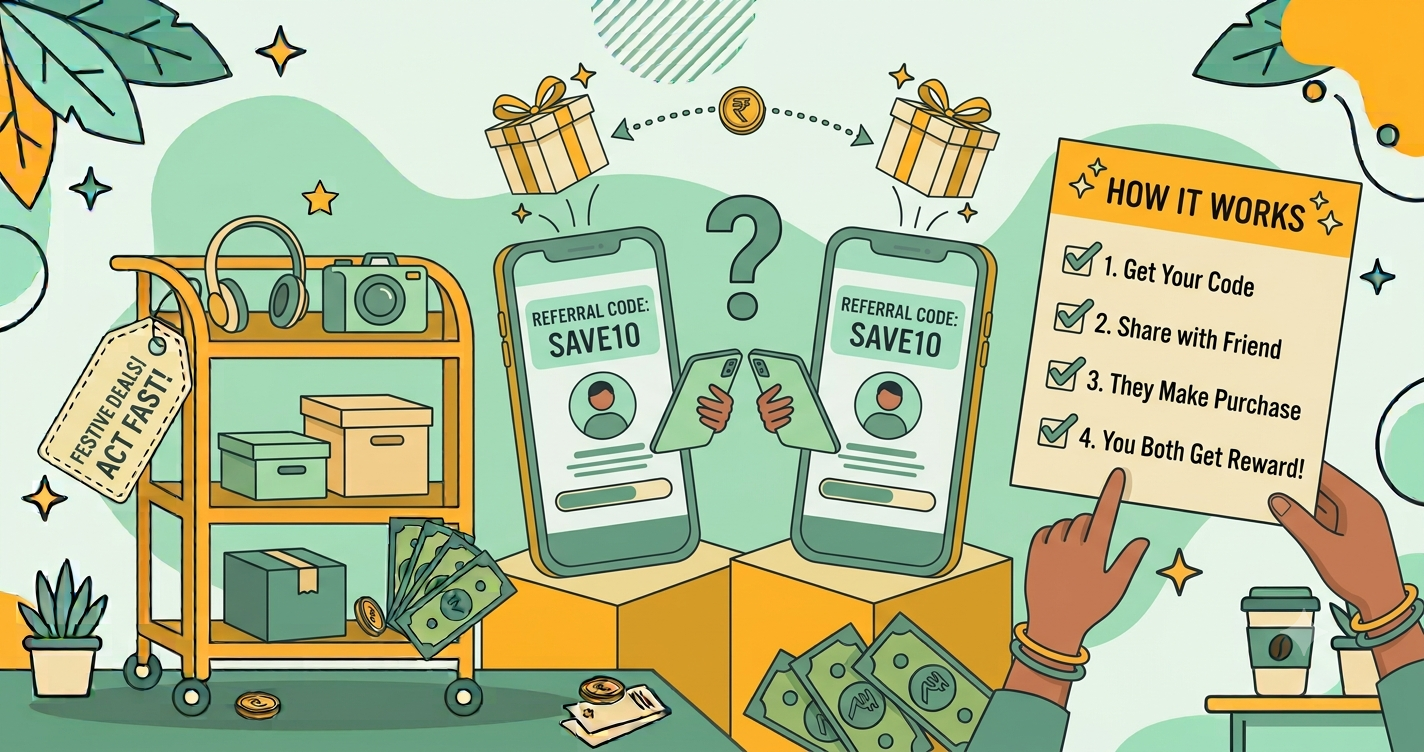
How a referral works, step by step
- You find your code or link in the app, usually under “Refer and earn,” “Invite friends,” or your profile.
- You share it with a friend through message, email, or social media.
- Your friend signs up using the link, or enters your code during registration or checkout.
- Your friend completes the qualifying action, such as a first order above a minimum value, a payment, or a subscription.
- The company verifies the action. This can include checking for returns, duplicate accounts, or fraud.
- Rewards are issued to you, your friend, or both, after a verification period.
Common conditions to read before you refer
Who counts as a new customer
The friend must usually be a first-time user, with a new phone number, email, and sometimes a new device. Existing customers or people who tried the service before often do not qualify.
The qualifying action
Signing up is rarely enough. Many programs require a first purchase, a minimum spend, a completed KYC process, or a number of transactions.
Reward type and form
Rewards may be wallet credit, coupons, points, cashback, or free products. Some can be used only on the same platform and may expire. See loyalty points and rewards for how to value them.
Limits and caps
Programs often cap the number of referrals, the monthly reward, or the total amount you can earn.
Verification period
Rewards may be held until the friend’s return window ends or until transactions are confirmed. This is similar to the pending status explained in how cashback works.
Expiry
Credit may expire in weeks or months. Note the date as soon as you receive it.
Termination and changes
Programs can be changed or ended at any time. Do not plan your budget around referral rewards.
A worked example (illustrative numbers)
A shopping app offers: “Refer a friend. They get 200 off their first order of 999 or more, and you get 150 in wallet credit after their order is delivered and the return window ends.”
- Your friend orders items worth 1,200 and applies 200 off, paying 1,000.
- After delivery and a 10-day return period, you receive 150 in wallet credit.
- Your credit expires in 60 days and can be used only on orders above 500.
The real value of your reward depends on whether you will shop in that app again within 60 days and meet the 500 minimum on something you actually need. If yes, the 150 is worth close to full value. If not, it may expire unused. And if your friend returns the order, your reward may be cancelled. This is the practical reality of referral rewards: they are worth what you can realistically use, as we also explain in how to stack coupons, offers and cashback.
How to refer people the right way
- Refer only products or services you actually use and trust. Your reputation matters more than a small reward.
- Be transparent. Tell your friend that you also receive a reward. Honesty keeps relationships healthy.
- Explain the conditions. Make sure your friend knows the minimum spend or expiry so they are not disappointed.
- Do not spam. Sending codes to large lists or posting them everywhere annoys people and may breach the program’s rules.
- Do not refer yourself through duplicate accounts. Programs detect this, and it can result in forfeited rewards or account suspension.
- Keep records. Save the terms and screenshots of your referral in case a reward is missing.
How to use a friend’s referral code as a new customer
- Ask for the code or link before you sign up. Codes entered after registration may not count.
- Check the conditions. Make sure the offer suits what you plan to buy.
- Compare with other welcome offers. A plain first order discount may be larger, as explained in first order discounts: when to use them.
- Apply the code carefully and confirm that the discount appears in your cart.
- Keep the order and reward details until the reward is fully credited.
Common reasons a referral reward does not arrive
- The friend already had an account or used the service before.
- The friend did not use your link or code at the correct step.
- The minimum spend or qualifying action was not met.
- The order was cancelled or returned.
- The reward is still in the verification period.
- The program’s cap or deadline had been reached.
- The system flagged the activity as suspicious, such as shared devices or addresses.
If a reward is missing, check the terms, then contact support through the official app with the friend’s order or sign-up details, your code, and screenshots. Avoid support numbers you find through search results, as fake support lines are a known scam.
Referral scams and red flags
Referral programs can attract fraud. Be cautious about:
- Pay-to-join schemes. Any program that asks you to pay a fee to start referring is a warning sign.
- Unrealistic earnings. Promises of large income from simply inviting friends should make you suspicious.
- Recruitment over product. If the main way to earn is by recruiting others who must also recruit, it may be a pyramid-style scheme, which is illegal in many places.
- Requests for OTPs, PINs, or passwords. A genuine referral never needs them.
- Fake referral offers by message. Links promising big rewards for sharing codes can lead to phishing sites. Read our online shopping safety guide.
- Selling referral codes. Paying a stranger for a code usually gives you nothing, and codes are free to share.
Privacy considerations
When you refer friends, you may be asked to allow access to your contacts or to share their phone numbers. Be careful. Sharing a friend’s details without their consent can breach their privacy and may break the program’s rules. Prefer manual sharing of your own link, and review the app’s permissions. Similarly, when you sign up through a referral, read what data the company collects and how it is used.
Are referral rewards taxable or reportable?
For small, occasional rewards, most people do not face complications. However, if referral income becomes significant or regular, tax treatment can depend on your country and the nature of the reward. This article is general information, not tax advice. If you earn substantial amounts, check current rules with official sources or a qualified professional.
Referral programs in different industries
The mechanics are similar everywhere, but the details change by industry. Shopping apps usually reward a first delivered order. Payment apps and banks often require your friend to complete verification and make a few transactions before releasing rewards. Food and cab platforms tend to offer small credits that expire quickly. Subscription and software services may extend your plan or give a free month. Before you share a code, look at what your friend must do and how long the reward lasts, so you can set honest expectations. A reward that needs ten transactions in thirty days is very different from one that needs a single order.
How to decide whether a referral reward is worth the effort
Think of referrals as a low-effort bonus, not a part-time job. Ask three simple questions. First, would I recommend this product to this friend even without a reward? Second, is the reward in a form I can realistically use? Third, will the effort of explaining the offer and following up cost me more time than the reward is worth? If the answer to the first two is yes and the third is no, go ahead. If not, skip it. A quick, honest recommendation is almost always better than a long chase for a small credit.
Referral programs and your budget
Never let a referral reward change your buying decision. A “free” 200 credit is not free if you spend 800 on things you did not need to use it. The same applies to your friends. If you recommend a product mainly because you will earn a reward, and it does not suit them, the relationship may suffer. Keep the focus on genuine value, and use rewards as a small bonus. For help staying within a plan, see shopping budget planning.
Frequently asked questions
What is a referral program?
A referral program, also called refer and earn, rewards you and a friend when the friend signs up or makes a purchase using your personal link or code.
How do I get my referral reward?
Usually your friend must sign up with your code and complete a qualifying action such as a first purchase. The reward is then credited after a verification period.
Why did I not receive my referral reward?
Common reasons are that the friend did not meet the minimum spend, was already a customer, used a different code, or the reward is still in the verification period.
Is it safe to share my referral code?
It is generally safe, since a code is not a password. Share it with people you know, avoid posting it in misleading ways, and never share OTPs, PINs, or login details.
Can referral programs be scams?
Some are. Be wary of programs that ask you to pay to join, promise unrealistic earnings, or reward you mainly for recruiting people instead of selling real products or services.
Final thoughts
Referral programs can be a friendly way to save and to help friends discover useful services. They work best when the product is genuinely good, the terms are clear, and the reward is a small bonus rather than the goal. Read the conditions, refer honestly, protect your data and your friends’ privacy, and avoid any program that asks for money upfront or rewards recruiting over real value. Done well, a referral is simply a recommendation with a small thank-you attached.